Quick answer
A kitten should eat a food made for kittens, labelled "complete and balanced" for growth, until about 12 months of age (ask your vet if your kitten is a large or slow-maturing breed). Split the daily amount on the pack into several small meals, keep fresh water out at all times, and change foods slowly over about a week.
Bringing home a kitten is a happy day, and a confusing one at the food shelf: dry bags, pouches, cans, "mother and baby" formulas and breed-specific foods all promise healthy growth. This guide explains what to look for on a label, how often to feed at each age, and how to choose between the kitten foods you can buy here. It is practical advice, not veterinary advice: if your kitten is unwell, very young or underweight, ask your vet first.
Why kittens need kitten food
Kittens grow very fast in their first year. Food made for kittens is formulated for that growth phase, which is why most kitten packs on sale in Bangladesh say they are for kittens "up to 12 months". Adult cat food is formulated for maintenance, not growth, so it is not the right everyday food for a young kitten.
You do not need the most expensive bag in the shop, but check three things before you buy:
- The life stage on the pack. Look for "kitten", "junior", "growth" or "mother and kitten". Some foods, such as Whiskas Junior Ocean Fish, are made for both kittens and pregnant or nursing mothers.
- The words "complete and balanced". A complete food can be fed on its own as the main diet. Treats, broths and some toppers are not complete and should stay small extras.
- The age range. Some foods start from 2 months, others from 4 months. Pick one that matches your kitten's age today.
What to look for on a kitten food label
A few lines on the pack tell you most of what you need.
A named animal protein near the top
Cats are carnivores, and kitten foods are built around animal protein. Look for a named source such as chicken, tuna, salmon or anchovy near the start of the ingredient list, rather than only vague terms.
Taurine
Taurine is an amino acid that cats need from their diet. Reputable cat and kitten foods add it, and it is usually listed in the ingredients or the additives section. If you cannot find it on a pack, choose another food.
DHA or omega-3
Many kitten foods add DHA, an omega-3 fatty acid often from fish oil, which brands include to support brain and vision development. It is useful to see, though not the only sign of a good food.
A feeding guide by age or weight
A good kitten pack prints a daily feeding guide. That guide is your starting point for how much to feed, so keep the pack, or take a photo of the guide before you move the food into a container.
Dry or wet food for kittens?
Both can work well, and many families use both. Our wet vs dry cat food guide goes into detail, but here is the short version for kittens.
Dry kitten food
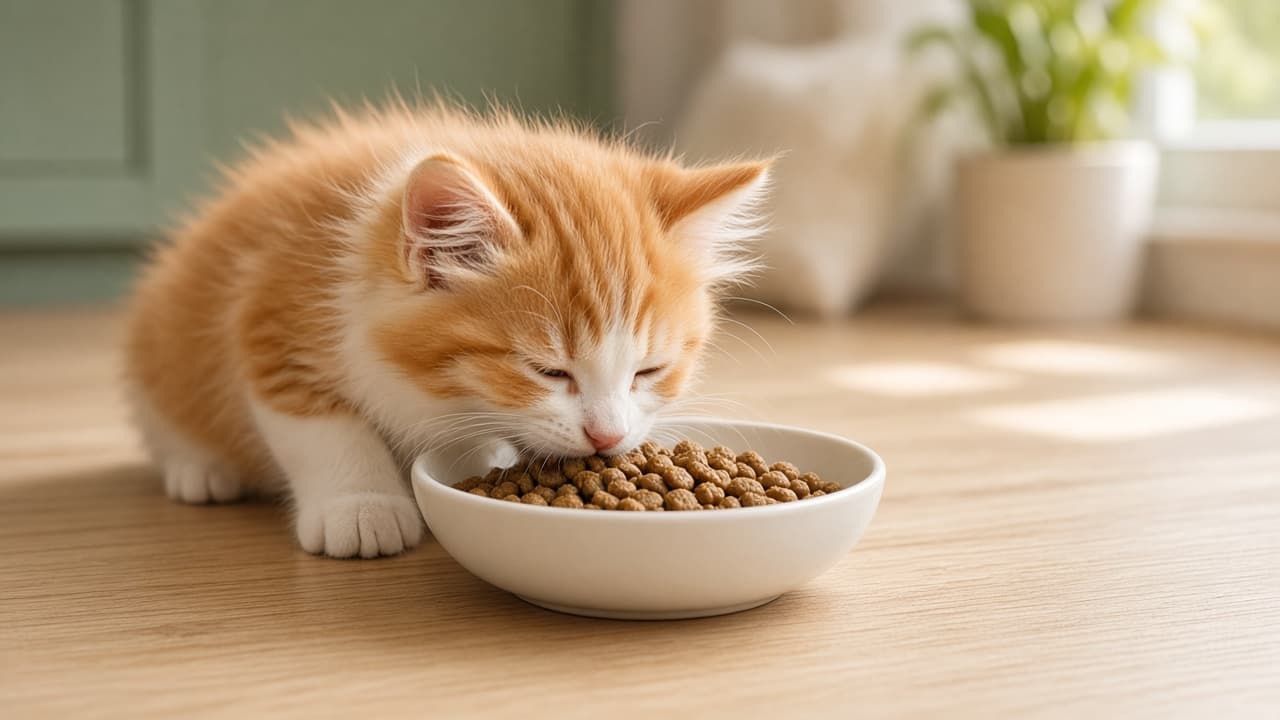
Dry food is convenient, easy to measure and usually the most economical way to feed every day. Kitten kibble is generally smaller than adult kibble so young teeth can manage it. For very young kittens, some packs suggest softening the kibble with a little warm water; Whiskas Junior, for example, says it can be served softened.
Dry kitten foods currently in our food & treats aisle include:
- Reflex Kitten Food, Chicken and Rice 2kg: chicken protein with rice, a full vitamin and mineral complex and taurine.
- Bonacibo Kitten, Chicken with Anchovy and Rice 1.5kg: a high-protein recipe that the maker also recommends for pregnant and nursing cats.
- Whiskas Junior Ocean Fish: for kittens from 2 to 12 months and mother cats, with DHA and calcium.
- Royal Canin Persian Kitten 2kg: made for purebred Persian kittens up to 12 months, with an almond-shaped kibble designed for their short, flat jaw.
Wet kitten food
Wet food is soft, smells strongly and contains a lot of moisture, which helps your kitten take in water with meals. Many kittens find it easier to eat while they are getting used to solid food. It costs more per meal than dry food and it spoils quickly once opened, so plan portions.
Wet kitten options in our shop include:
- Felix Kitten Tuna in Jelly 85g: labelled complete and balanced for kittens up to 12 months.
- Royal Canin Kitten Thin Slices in Gravy 85g: for kittens from 4 to 12 months and for mothers during pregnancy and nursing.
- Nekko Kitten Tuna Creamy with Salmon 70g: a creamy texture with small flakes, for kittens from 2 to 12 months.
- Wanpy Holistic Kitten Can, Salmon and Tuna 375g: a larger can that suits homes with more than one kitten.
If you choose a wet food, check the pack says it is complete. A pouch that is complete can be a full meal; one that is not should be a topper alongside a complete food.
Mixing both
A common routine is dry kitten food as the base with a wet meal once or twice a day. If you mix, reduce the dry portion so the total stays close to the pack guidance.
How often and how much to feed a kitten
Kittens have small stomachs and high energy needs, so they do better with several small meals than one or two large ones. As a general pattern:
- Young kittens (roughly 2 to 4 months): three or four small meals spread through the day.
- Growing kittens (roughly 4 to 6 months): three meals a day usually works well.
- Older kittens (roughly 6 to 12 months): two or three meals a day.
These are general patterns, not rules. For amounts, start with the daily guide on your pack, divide it across the day's meals, and re-check it every few weeks as your kitten grows. If your kitten seems constantly hungry, is not gaining weight, or is getting round quickly, ask your vet rather than guessing.
A few habits make feeding easier:
- Feed at roughly the same times each day, in the same quiet spot.
- Use a kitchen scale or measuring cup instead of filling the bowl by eye.
- Count treats as part of the day's food and keep them small.
- Wash bowls daily, especially wet-food bowls in warm weather.
Water matters as much as food
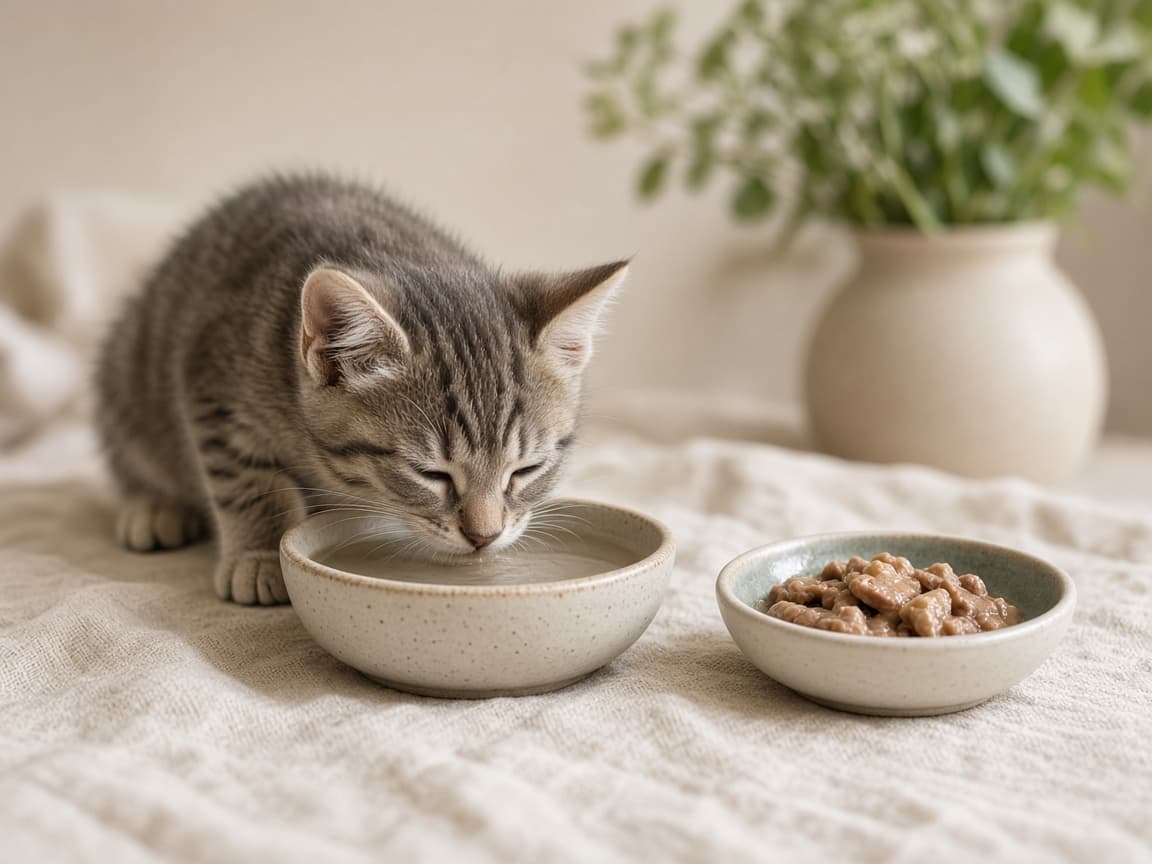
Fresh, clean water should be available all day, whatever food you choose. Kittens on mostly dry food need water close by. Place the bowl a little away from the food bowl and well away from the litter tray, change it at least once a day, and wash it often. Some kittens drink more from a wide, shallow bowl or a pet water fountain.
What about milk?
Once a kitten is weaned, it does not need milk. Cow's milk upsets many cats' stomachs, so it is best avoided. A kitten that is too young to eat solid food needs special care and a proper kitten milk replacer, so ask your vet straight away in that case.
Switching your kitten to a new food
Ask the breeder, shelter or family you adopted from what your kitten was eating, and keep to that food for the first few days. Moving home is stressful enough without a sudden diet change.
When you want to switch, do it gradually over about a week:
- Days 1 to 2: about one quarter new food, three quarters old food.
- Days 3 to 4: about half and half.
- Days 5 to 6: about three quarters new food.
- Day 7 onwards: all new food, if your kitten is eating well and stools are normal.
If your kitten stops eating, has loose stools that do not settle, vomits, or seems low in energy, slow down and ask your vet. Young kittens can become unwell quickly, so do not wait long.
Storing kitten food in Bangladesh's climate
Heat and humidity are hard on pet food, so storage matters here more than in many countries.
- Keep dry food in its original bag, rolled tightly and clipped, or put the whole bag inside an airtight container. The bag keeps the batch number and expiry date with the food.
- Store food in a cool, dry place, away from the kitchen stove and direct sun.
- Pick a bag size your kitten can finish while it is still fresh. A huge bag is not good value if it goes stale.
- Cover and refrigerate leftover wet food, and use it within the time stated on the pack.
- Do not leave wet food in the bowl for hours in warm weather. Remove what is not eaten and wash the bowl.
Human food and kittens
It is tempting to share rice, fish curry or meat from the family plate. Seasoned home food is not designed to meet a kitten's needs, and some common ingredients, such as onion, garlic and chocolate, are known to be unsafe for cats. Keep human food off the menu and ask your vet before offering anything new.
When kitten food ends: moving to adult food
Most kitten foods are designed for the first 12 months. Around your kitten's first birthday, ask your vet whether it is time to move to an adult formula, especially for larger or slow-maturing breeds, or if your kitten has been neutered. Use the same week-long switching method described above. Our cat food buying guide explains how to compare adult foods when the time comes.
A simple first-week shopping list
If you are about to bring a kitten home, this list covers food-related basics:
- A small bag of the food your kitten already eats, plus the kitten food you plan to move to.
- A few kitten pouches or a can for variety and extra moisture.
- Two shallow bowls for food and one for water.
- An airtight container or a strong clip for the dry food bag.
- Litter and a tray. Our cat litter guide explains the options, and you can browse the litter & tidy aisle.
For current prices on kitten and cat food, see our cat food price list. Delivery is ৳80 in Dhaka district and ৳150 for other districts, and it is free on orders of ৳3,000 or more of merchandise.